Prompts, Tokens and Temperature: AI Model Settings for AI-901
Understand the AI model settings AI-901 tests in objective 1.2: prompts, the system message, tokens, temperature and grounding - with exam cues.
Objective 1.2 of AI-901 asks you to identify AI model components and configurations. In plain terms: you need to know the knobs that shape what a generative model does — the prompt, tokens, the system message, and especially temperature. Here's what each one means and how the exam tests it.
The prompt
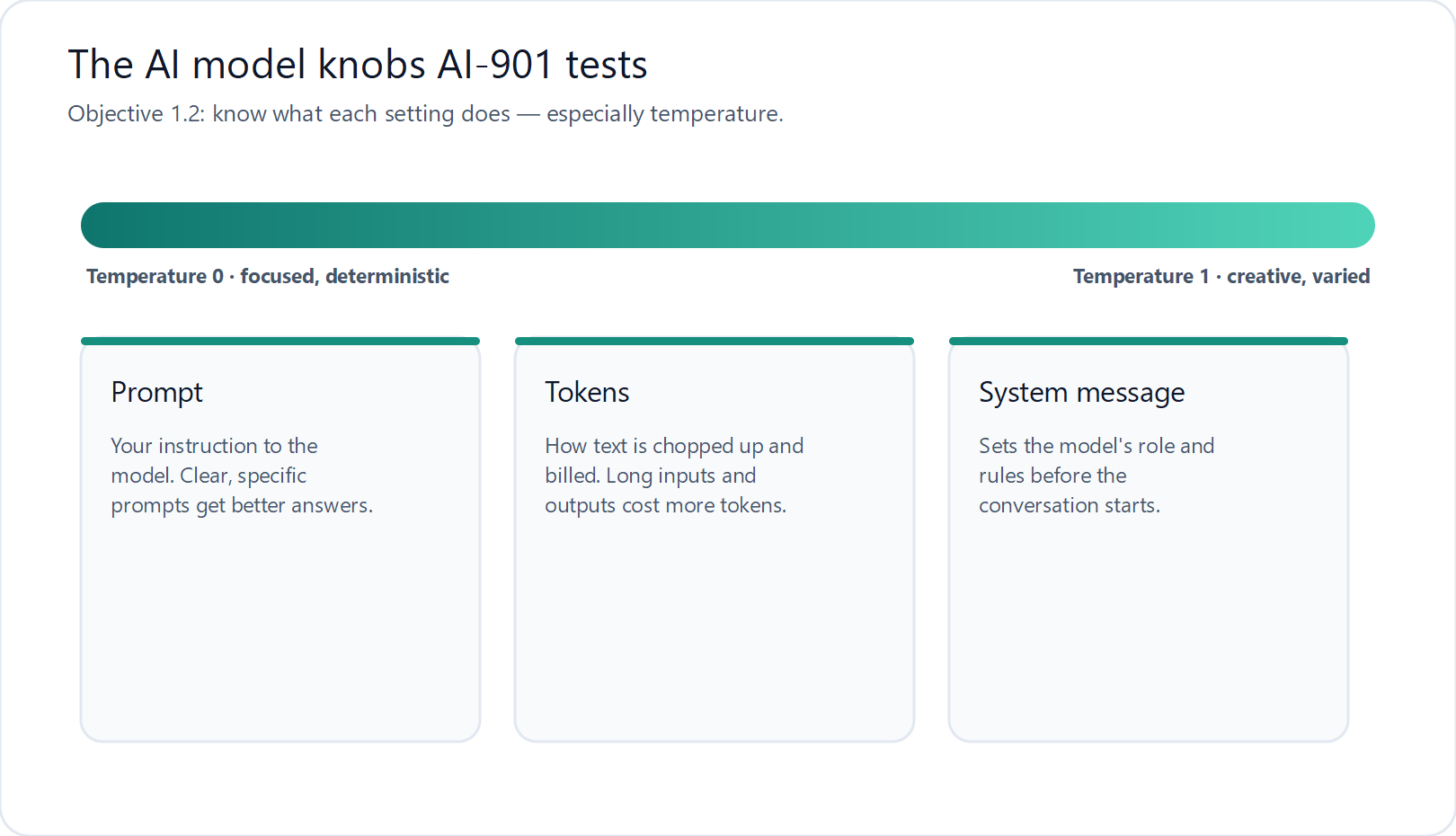
The prompt is the instruction you give the model. Clear, specific prompts produce better, more relevant answers — vague prompts produce vague answers. On the exam, “improve the quality of responses” often points to better prompting.
The system message
The system message sets the model's role and rules before the conversation begins — for example, “You are a helpful support agent; only answer questions about our products.” It shapes tone and boundaries for every reply that follows.
Tokens
Models read and write in tokens — chunks of text roughly the size of a short word or word-piece. Tokens matter for two reasons AI-901 cares about: cost (you're billed per token) and the context window (there's a limit to how many tokens a model can consider at once).
Temperature
Temperature controls randomness. A low temperature makes output focused, consistent and repeatable — good for factual tasks. A high temperature makes output more creative and varied — good for brainstorming, riskier for accuracy. This is the single most commonly tested setting, so remember: higher = more creative, lower = more deterministic.
Grounding (bonus, and it shows up everywhere)
By default a model only knows its training data. Grounding — often via Retrieval-Augmented Generation (RAG) — feeds the model your own documents so answers are current and accurate. If a question mentions “use your own data,” think grounding.
Quick recall table
- Prompt → the instruction.
- System message → the model's role and rules.
- Tokens → units of text; drive cost and context limits.
- Temperature → low = focused, high = creative.
- Grounding / RAG → connect the model to your data.
Start practicing AI-901 questions for free
Reading explains the ideas; answering questions is what makes them stick. Get a question wrong, read why, try again — that loop is what moves your score on exam day.
These settings click once you tweak them on real questions. On ExamStudyApp you can run a free AI-901 practice session right now — no account and no credit card required. Every Microsoft Azure AI Fundamentals question comes with a full explanation, so each one doubles as a mini lesson.
When you're ready for more, the Microsoft Azure AI Fundamentals (AI-901) practice tests add unlimited adaptive practice and timed, full-length mock exams with a per-objective score breakdown — so you know exactly what to review before you book.
▶ Try free AI-901 practice questions →